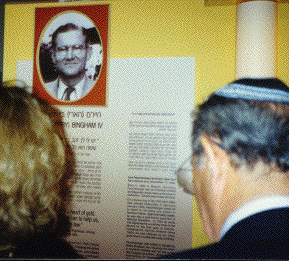
Photo: From "Harry's Wall" at Yad Vashem, Jerusalem
___________________________________________________
Return to the
Hiram Bingham IV Main Page | Press and Publications
___________________________________________________
A Diplomat's Quiet Battle To
Rescue Jews Emerges
By MAURA CASEY
HIRAM BINGHAM 4TH of Salem was known
to most as the son of the former United States senator who also
discovered the ruins of the ancient Incan city Machu Picchu in
Peru.
He died in 1988, but details have emerged of Mr. Bingham's hidden
life as a hero of the Holocaust. As a diplomat in Vichy France
in 1940 and 1941, Mr. Bingham issued hundreds of visas and, occasionally,
forged documents to help Jews and other targets of Nazi persecution
escape. He helped as many as 2,500 artists, writers and others
flee the Holocaust, historians said.
Bolstering the record is a cache of documents, letters and photographs
that Hiram's son William found several years ago in the family's
pre-Revolutionary Salem home. In a linen closet behind a fireplace,
among cobwebs and dust, William found evidence of his father's
past.
''There was a bunch of documents wrapped tightly together,'' William
Bingham said. ''They included my dad's journal, and notes from
people he rescued. Everything fell into focus at one moment. It
was almost heart-stopping.''
The papers corroborate what historians had begun to piece together
about the secret heroism of Hiram Bingham, about which Mr. Bingham
himself said little during his lifetime.
The documents inspired William to consult with and help prepare
exhibitions for the Simon
Weisenthal Center and the United States Holocaust
Memorial Museum, which led to his father's
nomination by holocaust historians and survivors for one of Israel's
highest honors: a medal awarded for being ''Righteous Among the
Nations'' and inclusion in the park at Yad
Vashem, literally, ''the place of names,''
Israel's National Holocaust Museum which is dedicated to non-Jews
who risked their lives to save Jews during the Holocaust.
Israel's requirements for considering anyone for such an honor
are arduous and demanding, said Eric Saul, guest curator for the
Simon Wiesenthal Center, and the Museum
of Tolerance in Los Angeles. But to
Mr. Saul, Mr. Bingham is clearly qualified for the honor.
Mr. Saul is an expert on rescue efforts during the Holocaust.
He created an exhibition on so-called ''righteous diplomats,''
including Mr. Bingham, who helped save Jews during World War II.
The exhibit includes the stories of 30 diplomats and has been
shown in a dozen cities all over the world.
After the exhibition traveled to Israel last year and Israel recognized
Mr. Bingham's efforts, another one of his sons, Robert Kim Bingham,
nominated his father for a particularly American honor: he asked
the United States Postal Service to issue a stamp in Hiram Bingham's
memory. That application is pending, bolstered by support by public
officials and Robert's neighbors, at least one of whom has collected
hundreds of names on a petition supporting the stamp.
Mr. Bingham was vice counsel in Marseille, France, when the Germans
captured Paris. Soon after, an American volunteer named Varian Fry traveled from New York to France at the behest
of what became known as the Emergency Rescue Committee, made up
of Americans who wanted to help people escape the Nazis. Mr. Fry
was placed in contact with Mr. Bingham by labor leaders and activists,
including early members of the French resistance, with whom Mr.
Bingham was organizing an underground network to help people flee
Nazi-occupied Europe.
- The documentary "Crown thy Good" about Fry and the ERC is due to be released in 2000.
- "Weapons of the Spirit" was also directed by Pierre Sauvage who was protected by the Nazi-occupied French village featured in this documentary.
- Other internet resources on Varian Fry and the ERC.
Bingham family lore has it that First
Lady Eleanor Roosevelt secretly supplied the first list of people
the committee helped, according to William Bingham. The efforts
of the committee were recorded in Mr. Fry's book, ''Surrender
on Demand,'' which he wrote soon after
the war. Because Mr. Bingham worked for the State Department when
the book was published, Mr. Fry played down his friend's role
for fear that the United States Government would fire or prosecute
him for violating State Department orders not to break the laws
of his host country, William Bingham said. Mr. Fry conveyed the
true impact of Mr. Bingham's activities in the inscription he
wrote in the copy of the book he gave to him, ''To a partner in
the 'crime' of saving human lives.''
Yet Mr. Bingham's help was crucial because he was the only diplomat
of the group and could gain access to documents and use other
advantages of his diplomatic status to help Jews escape. Mr. Bingham
even hid some people in his home after he sent his family -- he
then had four children -- back to the United States after the
Nazi occupation began.
Mr. Bingham helped pluck one writer, Lion
Feuchtwanger, from outside a prison
camp and drove Mr. Feuchtwanger to his home, insisting he dress
as a woman to disguise himself for two months until he could escape.
That rescue, and others by Mr. Bingham, were part of an exhibition
called ''Assignment Rescue: Varian Fry and the Emergency Rescue
Committee.'' It was shown for two years at the United States Holocaust
Memorial Museum in Washington from 1993 to 1995, said Shana Penn,
director of media relations for the museum.
''Bingham is remarkable because he was willing to respond to orders
from the State Department -- orders that went against his grain
-- appropriately,'' said Susan Morgenstein, consultant to the
United States Holocaust Memorial Museum.
Ms. Morgenstein is a consultant who was hired by the Holocaust
Museum to be curator for the Fry exhibition. ''In the south of
France, Mr. Bingham responded in his own humane and righteous
way for the good of our nation perhaps at a time when his superiors
were giving orders that went against that good land we should
be,'' she said. ''He can be credited for going with his instincts
for good, and against what he knew was ill-intentioned.''
Because Mr. Bingham worked in the visa section, he was able to
issue visas to thousands of people. Among those Mr. Bingham helped
escape were the artists Marc
Chagall and German surrealist painter
Max
Ernst, painter and writer Andre Masson, writers Victor
Serge and Franz
Werfel and Nobel Prize-winning physiologist
Otto
Meyerhof. A letter from the author Thomas
Mann survives, dated Oct. 27, 1940. It says, ''My brother Heinrich Mann and
son, Golo, since their arrival in the United States have repeatedly
spoken to me about your exceptional kindness and . . . help to
them in their recent need and danger.''
- more on Andre Masson
- read bio of Victor Serge's son and Mexican artist Vlady
- more on Franz Werfel
- more on Heinrich Mann
Yet Mr. Bingham's career was also in
jeopardy. A Sept. 14, 1940 order from the State Department instructed
consuls against helping the emergency rescue committee: ''However
well-meaning their motives may be, they are carrying on acts evading
the laws of countries with which the United States maintained
friendly relations.''
And Mr. Bingham also experienced frustration that he couldn't
help more people, William Bingham said. ''My father felt terrible
that he couldn't help many of the poorer people,'' he said. ''Many
of the people he helped had to have an American sponsor, someone
to vouch for their financial well-being, relatives in the states
or have some kind of a job.''
In the spring of 1941, Mr. Bingham's superiors discovered his
activities and transferred him out of the visa section. Perhaps
because his father had been a senator, or perhaps because he hid
his activities so well, he was not prosecuted for violating the
law, but the State Department later retaliated by transferring
him to the United States embassy in Buenos Aires and giving him
nonpolitical work. There he continued to monitor the activities
of the Nazis and protested when it became clear that war criminals
from Germany were escaping to Argentina. When his protests were
ignored, he resigned, just a few years before he would have qualified
for a pension.
''According to everything I read, he completely violated American
policy,'' Mr. Saul said. ''American policy was to help nobody,
especially Jews, because Jews were communist sympathizers and
labor organizers. For Bingham, all of a sudden, to openly support
Jews was to give up a diplomatic career, and he must have known
that.''
J. D. Bindenagel, special envoy for Holocaust issues at the State
Department, said he was not aware of Mr. Bingham's efforts, but
also noted that he didn't believe the department has ever recognized
any American diplomat who helped people escape the Nazis during
the war.
According to Mr. Saul, at least two other American diplomats helped
the Jews in Europe. He has documented the activities of 50 diplomats
who helped Jews escape, including the two Americans, three papal
nuncios (one of whom, Archbishop Angelo Giuseppe Roncalli, later
became Pope John XXIII) a Chinese diplomat and a Turkish Moslem.
Most of the diplomats, including Mr. Bingham, were little known
before Mr. Saul started his research several years ago, and even
the diplomats' families were often in the dark.
Mr. Saul explained that, of the one million Jews who survived
the Holocaust, diplomats helped save about 250,000.
When he speaks with surviving family members such as the Binghams,
Mr. Saul said:
''We go on this journey together. Their fathers, for the most
part, have passed on. And they discover these heroic, compassionate,
loving fathers who they really never knew. You can see the Holocaust
as a black hole of unredeemed evil, but you look at the stories
of the rescuers and you can go on. There is hope in the world.''