HIRAM BINGHAM IV * LIST OF DOCUMENTS
Return to home page
*************************************************************
THE DOCUMENTS LISTED BELOW
WILL SHOW:
I.
EVIDENCE OF HIRAM BINGHAM
IV’S LIFE SAVING ACTIONS.
II.
EVIDENCE OF HIRAM BINGHAM
IV’S ACTIONS CONTRARY TO HIS
IV.
EVIDENCE OF THE NUMBERS OF
REFUGEES SEEKING HIS HELP.
V.
EVIDENCE OF DANGER TO
DIPLOMATS HELPING JEWS.
VI.
EVIDENCE OF HIRAM BINGHAM
IV’s EFFORTS TO HALT NAZI INFLUX INTO SOUTH AMERICA and that HE FELT
ANTI-SEMITISM WAS PART OF THE “NAZI
DISEASE.”
VII.
EVIDENCE OF HIRAM BINGHAM
IV’s DISAPPOINTMENT OVER BEING PASSED OVER FOR PROMOTIONS, POSSIBLY DUE TO HIS
INDEPENDENT ANTI-NAZI EFFORTS.
VIII.
EVIDENCE OF EVENTS RECOGNIZING HIRAM BINGHAM IV’S LIFE SAVING ACTIONS.
IX.
EVIDENCE AND PHOTOS THAT CAN
BE SEEN ON A WEBSITE HONORING HIRAM BINGHAM IV.
X.
EVIDENCE OF SOME OF THE NEWSPAPER ARTICLES HONORING HIRAM BINGHAM IV’S DEEDS.
I. EVIDENCE OF HIRAM BINGHAM IV’s LIFE SAVING
ACTIONS:
- M. Friedrich HEINE LETTER,
says to HB IV: “Thanks to you and
your understanding of the situation, probably more than 1,000 refugees
have been saved.”
- LETTERS FROM FEUCHTWANTER, CHAGALL and others
reveal Hiram Bingham’s crucial part in their rescues. (See letters below.)
- Varian FRY BOOK INSCRIPTION notes: “To Hiram Bingham, Jr. Partner in the ‘crime’ of saving human
lives.” (Fry is credited with
saving over 1500 lives, and he calls Bingham not just a helper, but a
“partner,” in this work.)
- FRY MANUSCIPT expresses essential work of Hiram
Bingham IV “His going…may seriously cripple our work” (see excerpt at page
534, below):
VARIAN FRY MANUSCRIPT PRAISES HARRY’S RESCUE
WORK
Bill Endicott wrote:
On Wednesday, August 6, Abbie [Abigail Bingham Endicott, daughter of Hiram Bingham
IV and wife of William] and I made another trip to see Elizabeth Berman
[retired from
Excerpt at Page 10: The text of article 19, as
cabled from
NOTE:
FEUCHTWANGER IS CALLED PUBLIC ENEMY NO. 1 TO THE NAZIS:
Excerpt at Page 62: “Everyone agreed that it was
going to be extremely hard to save Feuchtwanger,
wherever he was. He was Public Enemy No. 1 to the Nazis, they thought.” [This
is the man Harry Bingham hid in his home – see below, ed.]
NOTE: FRY
SPEAKS OF THE LOSS FROM HARRY’S GOING:
Excerpt at Page 534: “Wednesday, May 7. Harry
Bingham told me this morning that he has just received instructions to go to
Excerpt at Page 556: “Sunday, May 25. The new man in charge of visas at the
Marseille Consulate is young and inexperienced. This is his first post. Afraid
of making mistakes, he tries to solve his problems by refusing visas whenever
he can. But he is also a snob. The other day I talked to him about just two
cases, both women. One was a German Social Democratic underground worker. She
had a good affidavit. The other was the Countess X. She has no affidavit at
all. B______ refused to give a visa to
the German political refugee. ‘How do I
know she won't do underground work in the
[Once again, very detailed Fry description of
Harry's value in comparison with what came after he left. – Bill Endicott]
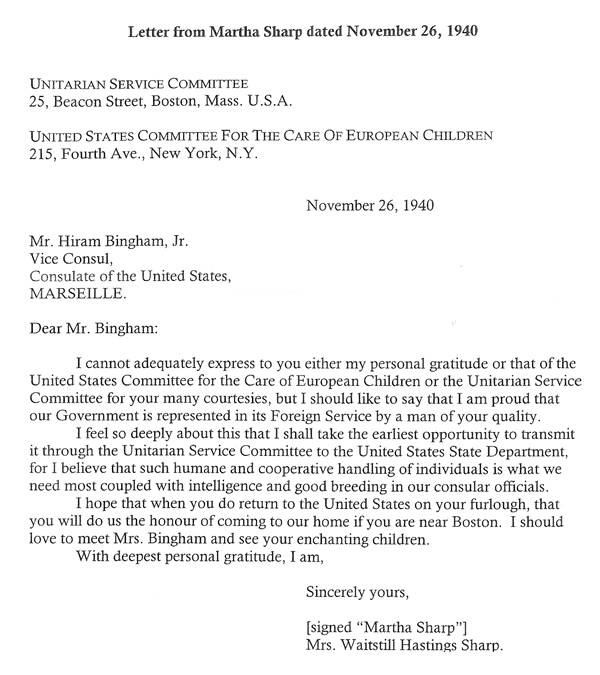
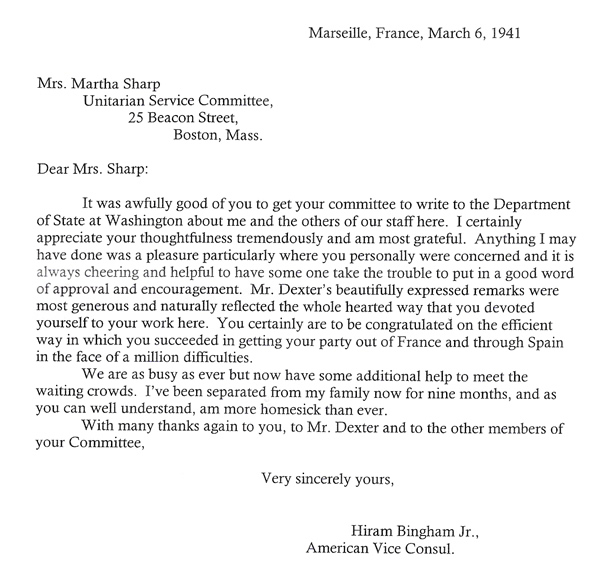
II. EVIDENCE OF HIRAM BINGHAM IV’S ACTIONS
CONTRARY TO HIS
1.
TAPED HBIV INTERVIEW with
his granddaughter, Tiffany M. Bingham:
(Transcript
Page 5) HB IV: “…my boss who was the
Consul General at that time, said, ‘The Germans are going to win the war. Why should we do anything to offend
them?’ And he didn’t want to give any
visas to ‘these Jewish people.’ So, in a
way, I had to do as much as I could.”
2.
Program from AMERICAN
FOREIGN SERVICE ASSOCIATION, Posthumous AWARD for “CONSTRUCTIVE DISSENT.”
Presented by Secretary of State Colin Powell on
3.
FEUCHTWANGER/WETCHEEK
case. The noted German anti-Nazi writer,
Leon Feuchtwanger, was on the Gestapo arrest
list. Hiram Bingham IV, not only issued
him a visa under a false name, he hid him illegally in his house. The facts are documented in Fuechtwanger’s own diary, in German. William T. Endicott has translated a portion
below:
AUTHOR FEUCHTWANGER'S DIARY ENTRIES WHILE HIDING IN HARRY'S
MARSEILLE RESIDENCE: [In these passages it seems pretty clear that, among other
things: Harry was part of an "underground railroad," engaged in
smuggling people out of
TRANSLATION OF FEUCHTWANGER DIARY 1940 - SELECTED ENTRIES,
Original German version courtesy of Feuchtwanger
Memorial Library, Specialized Libraries and Archival Collections, University of
Southern California]:
Marseille, Monday 22 July: Bingham is an awkward, friendly,
puritanical, dutiful, somewhat sad New Englander, who is very attached to his
wife. He very much misses her and his children who have been removed to
Marseille, Sunday, 28 July: With Bingham personal
understanding is getting better. Towards evening, however, while I am speaking
with him, he gets a telephone call from his consul-general, which puts him into
a sharp conversation. It's about a quite unimportant matter, but he is totally
troubled, and I fear that my own thing will be unfavorably influenced by this
coincidence. Nevertheless, he explains very confidentially about his difficult
position in the Consulate, and our personal relations improve.
Marseille, Monday 29 July: At noon Lilo
arrives. In the camp on the day of my abduction French officers, who were
supposed to bring me away, were looking for me. When they can't find me, there
is great excitement and poor Wolf is suspected of an
abduction in collaboration with the Nazis. Everything
a bit dark. Lilo's husband is in Sanary [French town where Feuchtwanger
had been living for 8 years -- ed]. In our house a
certain Joachim, a refugee is also lodging. In the evening Bingham is in a
happier mood. For the moment, his clash with the consul-general has had no
consequences. General conversation about national economic
problems.
Sunday, 4 August: Bingham hints that I should leave, he
fears that it will be too dangerous for him if I stay too long in his house.
After that he made a portrait of me. I read. Worked.
Bingham expresses regret and explains that of course he still wants to keep me
here.
Monday, 5 August: Just after she [Marta- ed]
left, my tent friend Wolf [a fellow transit camp internee - ed] telephones.
That's very pleasant. It's also good that the maid believes that the caller is Golo Mann and not Wolf, because Bingham is not supposed to
know that with the exception of Golo Mann, no one
knows that I am living in his house.
Wednesday, 7 August: Slept very badly. Wonderful
weather. Standish and his wife are there for breakfast, I am awkward.
Then, quite unexpectedly, Lilo arrives with her
husband. She says it is too dangerous
for me to return to Sanary and advises that I should
dog Bingham as long as possible and that I should try hard to obtain a fake
French document. But Mr. Brousse, through whose
intervention that might work, is not here. In the afternoon, spoke to kind Loewenbein, but he also had no advice. In the evening
Standish is here again; he wants to speak with a flyer about whether he would
perhaps fly me to
Saturday, 10 August: At
Sunday, 11 August:
At
Marseille, Monday, 12 August: Wonderful weather. Slept OK. The prospect of escape lifts my mood, but the
impending hardships and dangers make me nervous. Worry about whether I can take
Marta with me. But Bingham takes it as obvious. Worked a bit.
Saturday, 17 August I try to suggest to Bingham that he should give me a visa
with the name Wetcheek. He goes along with it and is
happy that he thought of it himself. We have a lively conversation.
Then Bohn phones, and shares that
the boat will indeed go, wants gas from the Wolfs. Bohn and another American
from his people, Fry, eat here in the evening. Many problems emerge. Gabbed quite a lot with Bingham.
Thursday, 29 August: Bingham in a bad mood. I did not sleep
long enough. A lot of unpleasant little things to think
about. Then Wolf arrives and reports that the whole story with the exit
visa and
4.
THANK YOU LETTER FROM
FEUCHTWANGER/WETCHEEK: Feuchtwanger wrote a thank you to HB IV in letter under pen
name of “Wetcheek” as was used in the visa Hiram
Bingham IV gave him to escape
[Printed Letter Head:]
American Export Lines
On
Board
S.
S. EXCALIBUR
My dear Harry Bingham, 28th
Sept. [1940]
Well, here I am, I can not [sic]
believe it yet. Now, I should have to
write a nice letter full of thanks, but I will not, I think, it does not need, you
know exactly what I am feeling for you.
Let me only repeat that it was a great chance that it was not Mr. X or
Mr. Y, in whose house I had to face these bad days, but yours. I ever shall remember with pleasure those
some good talks we had.
When you will get this letter, you
certainly will be informed how all happened.
It was a great stress all at all, [sic] I feel a little exhausted, I
miss my things, I have only this famous rucksack, but I feel happy.
Well, I hope to see you soon in
Yours
for ever
Wetcheek
5.
Marc CHAGALL letter in 1941,
revealing deep emotions and ongoing relationship to the unnamed (because
dangerous to name him) “bon ami,” Hiram Bingham. (This letter is from the personal letters
found in the Bingham family home after Hiram Bingham IV’s death.) The letter is written in Chagall’s own hand,
in French. Here is the English
translation by Hiram Bingham’s daughter, Abigail Bingham Endicott with help
from a French neighbor, Laurent Durix: (See below.)
[Printed Letter Head:] GORDES
[Vaucluse]
le15/III 41
Our good
friend
Your good
letter has touched us infinitely.
And what
splendid photos!
Thank you with
all our hearts.
We had a great
deal of pleasure in spending with you these last two days.
Alas, the
hours slipped away too fast and we are left very sad after your departure.
We keep a
touching memory of your short stay and your beautiful photos revive it even
more.
We will always
be happy to see you.
Until very
soon!
Most
sincerely,
The
Chagall’s
6.
Lillian WINKLER STUART SMITH
LETTER: Family was refused visas by American consulate in Lyon, but HB IV
helped this family of the publisher of anti-Nazi articles. Calls HB IV “a most generous
and courageous man.”
(See
Foreign Service Journal, June 2002, page 22.)
7.
Pierre and Walter Shostal letters:
Were approved for one visa only until HB IV “jumped the hurdle” and gave
a single visa for the whole family.
8.
Letter from Fred Altmann: Very moving
letter of thanks for HB IV’s “Heart and Soul”, and his “conception of
humanity…” in recognizing the situation and writing a letter of
introduction. Altmann
plans to write a “little work” called “Triumph of Humanity”
III. EVIDENCE OF HIRAM BINGHAM IV’S
UNDERSTANDING OF THE EXTREME SITUATION, GIVING HIM MOTIVATION TO HELP:
Appendix IV of his Report on
the Concentration Camps in
1.
Maps, his drawings and
reports on desperate conditions in the camps.
2.
Transcript of his interview with Tiffany M.
Bingham:
a. Page 4: “just before the
war, my wife and I had made a trip to Germany and had seen the broken windows
where the Jewish stores had all been smashed and there were signs in the
restaurants ‘No Jews or Dogs Allowed.’”
b. Page 6: “He [Feuchtwanger] wrote a book, a novel called ‘The Oppermans,’ which is still an interesting book about what
happened to a Jewish family under Hitler.”
HARRY BINGHAM VISITS FRENCH CONCENTRATION CAMPS
Compiled by William T. Endicott
How many people know there were concentration camps in France during World War II? Well, there were at least 27 of them in southern France alone, as a report by Harry Bingham reveals.
While the term “concentration camp” is used offciially to describe these camps, it is true they were not the same as the more deadly extermination camps in Germany and Poland, such as Auschwitz. While people were dying in the French camps -- Harry's report says it was 17 people per day -- is was not as the result of a deliberate effort to externinate them but rather the result of inadequate food and sanitation. But it is also true that the French camps were sometimes used as a first step towards exrermination; some inmates of the French camps were later transferred to the extermination camps.
The French camps were begun during the Spanish civil war to house the thousands of refugees spilling over into France as a result of that conflict. After the Nazis conquered France in 1940, the camps were simply reused for the flood of refugees from the Nazis.
From November 27 to December 1, 1940 Harry Bingham visted 5 of these camps and it is interesting to note that he had to do it on his own initiative and at his on expense. In a December 13 letter to Howard R. Kerchner, American Consul General Hugh Fullerton, Harry's boss, wrote: “....As you doubtless know, Mr. Bingham's trip to the camps was in nowise official and under instructions from the Department of State. It was, in fact, made at his own expense...”
The following are excerpts from 28 pages of documents pertaining to that trip:
1. EXCERPTS FROM HUGH FULLERTON'S COVER MEMO
AMERICAN CONSULATE
Marseille, December 20, 1940
Subject: Concentration camps in Southern France
THE HONORABLE
THE SECRETARY OF STATE,
WASHINGTON.
SIR:
I have the honor to transmit herewith a report in the form of a Memorandum prepared by Vice Consul Hiram Bingham, Jr., following a recent brief tour made by him, with my approval to five of the largest and most important concentration camps situated in the Marseille Consular District --- the camps at Gurs, Vernet, Argeles-sur-Mer, Agde and Les Miles (near Aix-en-Province).
PURPOSE OF VISIT -- IMMIGRATION PROBLEMS.
The trip was made primarily for the purpose of giving information, with a view to reducing the volume of visa correspondence and the number of callers from the camps.
The Consulate at Marseille has been receiving an average of four hundred letters per day from prospective immigrants or other persons desiring visas for the United States. A large proportion of the visa correspondence comes from the thousands of persons, applicants for visas(estimated at over 7,000) who are included in the 50,000 or more foreigners, refugees and “suspects” now confined in the concentration camps...
...The trip was made in the company of Dr. Donald Lowrie, Chairman of the coordinating committee of organizations doing relief work in the camps (Comite de Coordination pour l'assistance dans les Camps”). This “Coordination Committee” was organized at a meeting at Nimes on September 20, 1940, to which were invited representatives of the following 20 organizations, all of whom have been engaged in some form of service in the internment camps:
American Friends Service Committee,
American Friends of Czechoslovakia,
Belgian Red Cross,
Centre American de Secours,
Comite d'Assistance aus Refugies,
Comite Central des Organizations Juives d'assistance en France,
European Relief Fund,
Federation Francaise des Associations Chretiennes d'Etudiantes,
French Y.M.C.A.
French Y.W.C.A.
H.I.C. H. M. (HIAS-JCA Emigration Association. Jewish Inernational
Migration Service)
Joint Distribution Committee,
C.R.T.
Polish Red Cross,
Polish Y.M.C.A.
Secours Suisse aux enfants,
Union des Sociietes O.S.E.
Unitarian Service Committee,
World's Commitee Y.M.C.A...
2. HARRY'S REPORT
MEMORANDUM
Regarding: Concentration camps for Foreigners in the Marseille Consular district.
Date: December 20, 1940
Prepared by: Vice Consul Hiram Bingham, Jr.
__________
Of the twenty or more concentration camps located in unoccupied France (see list attached to this memorandum) five of the largest and most important were visited in the course of a trip made November 27th to December 1st, 1940.
A rough estimate of the number of persons at the camps visted is as follows:
Camp de Gurs......................................12,800 inmates (including about 5,000 women and 1,000 children).
Camp de Vernet.....................................5,000 inmates (all men)
Camp d'Argeles...................................15,500 “ (including 3,000 women and 1,500 children).
Camp d'Agde.......................................13,060 men, women and children. Capacity: 20,000.
Camp des Milles........................................106 inmates (men -- capacity being prepared for 2,000 -- former maximum number was about 4,000)...
...THE CAMP AT GURS -- GENERAL CONDITIONS -- HOUSING, etc...
The camp at Gurs is located on the top of a long rolling hill about 1 1/2 kms. from the village of Gurs in the Department of Basses-Pyreneees about 15 miles from Pau.
The day the camp was visited it was a cold, cloudy wet day -- a “typical” day at this time of year. There are no trees or vegetation of any kind in the confines of the camp. The whole surface is damp, exposed and muddy. A paved highway runs for two kilometers along the side of the camp and a gravel road has been run down the center.
The majority of the barracks which house the present number of 12,500 internees appeared to be old and somewhat dillapidated and weather-beaten. There were a number of different kinds, some covered with tar paper, some made of corrugated iron or shiny metal sheets and some of simple wooden boards with and without windows around the top... Judging by the few little pipes with smoke escaping, only a small proportion of the buildings could have been heated.
PERSONNEL AND NUMBERS AT GURS.
“... about six thousand Germans had arrived directly from Germany having been expelled on very short notice and with no chance to bring with them more than a very small proportion of their belongings. The German Jews were said to be of all ages including a large number of old men and women and young children. About 7,000 persons had reportedly arrived from Lorraine and several hundred foreigners of all nationalities had come from other camps and cities in the non-occuped portion of France. ... The oldest inmate at Gurs was said to be 104 years old. Several babies were born there in the past few weeks.
INSUFFICIENCY OF FOOD
... Each person receieved (and this applied as fas a could be seen to each of the camps visited) about 350 grams of bread each morning which had to last all day. Such other food as was obtainable such as vegetables, sometimes “semoules” and occasionally meat was put into the soup which was served twice a day as lunch and supper ... the soup was often cold or filled with sand and dirt before reaching the barracks furthest from the kitchen.
SANITARY CONDITIONS -- POOR
Sanitary conditons at all of the camps visted were primitive. At Gurs the latrines consisted of out-houses raised over an open row of exposed garbage cans...To be reached one had to brave the outside cold and walk over 50 to 100 yards of muddy ground. Such washing as was possible might be done in long uncovered wooden troughs. Few of the people in any of the camps had any cots to sleep on or even wooden bunks. Many persons were even without straw to place on the floor and at the Camp at Argeles-sur-Mer many if not most of the barracks were without floors and the Commandant told us that a number of women and children had to sleep on the damp sand...at least 60 persons were understood to share each of the long wooden buildings or barracks...Some barracks, notably the barracks for women at Argeles-sur-Mer were reported to be infested with rats and mice and lice which disturbed sleep and were not pleasant to have around particularly where there were many small children.
ORGANIZATION OF CAMPS -- GROUPS DEPENDING ON SEX, NATIONALITY, ETC.
... At Gurs there are large sections of German Jews, French from Alsace and Lorraine, Spanish and some of various other nationalities including Russians, Poles, Czechs, Belgians, etc. ...
... At Argeles there are still six hundred German Jews ....They were of course the group that demanded the most and were most generally anxious to emigrate to the United States...
... A “special” camp at Argeles, more heavily guarded than the rest, housed those men who had tried to escape or had in other ways misbehaved ...
... Discipline at he Camp at Vernet appeared to be much more severe than at the other camps visited. ... One section of the camp was reserved for communists of all kinds and another for extremists and anarchists...
... POSSIBILITIES OF IMPROVEMENT
... The possibility for improvement is, of course, limitless, but with such restricted means and so much real need in the cities and country throughout the unoccupied portion of France, it is understandable that the French Government does not feel it can do much more than it is doing for the numbers of refugees and unwanted foreigners now crowding the camps.
There is some reason to believe, according to one well-informed Frenchman, that the Germans wish conditions in the camps to be “hard” and will endeavor to keep them so by dumping thousands of new refugees from Germany and the occupied part of France into the unoccupied zone where they must necessarily complicate the whole problem. By doing this their own concentration camps in Germany would appear in a favorable light, particularly as regards sanitation. They also may wish to “convert” the inmates by an “example” of inefficiency and incompetent management as well as callous inhumanity on the part of persons brought up in a “democratic” system. When the shortage of food becomes more acute, the camps may be used as centers of unrest. Disturbances and anti-foeign sentiment may be accentuated and organized against the buyers of provisions for the camps in local markets. Resulting riots may be used if desired as an escuse for intervention and military occupation of the whole of France. ...
3. LIST OF CAMPS
APPENDIX No. 3 to memorandum enclosed with Despatch number 82 of December 29, 1940, regarding “Concentrattion Camps in Southern France”.
______________________
Statistics prepared by Coordination Committee
Figures based on estimates as of November 20,1940
________________________
[List summarized here from 4-page original -- ed. ]
AGDE. Capacity 20,000 - present population: 3,060
ARGLES Capacity 25,000 - present population: 15,500
AIGUE BLANCHE Capacity ? - present population ?
HOTEL BOMPARD Capacity ? - present population: 100
BRAM Capacity 50,000 - present population: 3,000
BRENS-GAILLAC Capacity 4,000 - present population: 3,000
CARPIANE Capacity ? - present population: 3,060
CAYLUS Capacity ? - present population: ?
CHAUX D'ANE Capacity ? - present population: 500
CLAIRFONDS Capacity ? - present population: ?
FORT-BRKSCOU Capacity 100 - present population: ?
CARRIGUES Capacity ? - present population: ?
GURS Capacity 22,000 - present population:14,000
LES MILLES Capacity 4,000 - present population: 3,000
LORIOL Capacity ? - present population: ?
MAS BOULBON Capacity ? - present population ?
MONTAUBAN Capacity 1,300 - present population: 150
MONTELIMAR Capacity ? - present population: 250
RECEREDOU Capacity 3,000 - present population: 300
RIVESALTES camp under construction
RIEUCROS Capacity 1,500 - present population: 1,500
SEFTFONDS Capacity 6,000 - present population: 1,000
SAINT ANTOINE Capacity ? - present population: 1,000
SAINT-HIPOLYTE Capacity 1,500 - present population: 1,000
SAINT-MARTHE Capacity 10,000 - present population: 250
SAINTE-NICOLAS Capacity ? - present population: ?
VERNET Capacity ? - present population: 4,500
Total population of camps: 54,850
of which: women: 8,341
children: 2,295
N.B. In addition there are about 100 camps of:
a) “prestataires”
b) foreign workers
making a total of nearly 25,000 men.
______________________
4. STATISTICS ON DEATHS IN THE CAMPS
APPENDIX No. 4 to memorandum enclosed with Despatch number 62 of December 20,1940 regarding “Concenrtation Camps in Southern France”.
______________________
Based on reports received from reliable persons interned in the camps.
November-December 1940.
GURS:
Number of deaths: -
About 300 deaths during November 1940
150 deaths during first 10 days of December
Deaths listed in one day:-
4 from chronic heart disease
7 old people
1 45 yr old woman from malnutition
1 16-yr old diabetic patient
1 baby of 4 months
1 two year old child from entiritis
1 16-yr old from polycephalitis
1 40-yr old woman from lung trouble
___________
17 total
Top
IV. EVIDENCE OF NUMBERS OF REFUGEES
SEEKING HIS HELP:
1. Letter from HB IV 9/40 to his wife RMB “hectic day…at least 100 callers – and many visas to give.”
2. Photo of people waiting outside the consulate.
V. EVIDENCE OF DANGER TO DIPLOMATS HELPING JEWS:
1.
Evelyn Leopold UPDATE April
4 Reuters:
- Turkish consul-general on Rhodes, Selahattin Ulkumen, had house
bombed and his pregnant wife was fatally wounded when he stopped
deportation of 42 Jewish families.
2.
Swedish diplomat Raoul Wallenberg disappeared while helping Jews in
3.
Feuchtwanger diary (above) shows Hiram Bingham felt in danger:
Sunday, 4 August Bingham hints that I should leave, he fears that it will be too dangerous for him if I stay too long in his house. After that he made a portrait of me. I read. Worked. Bingham expresses regret and explains that of course he still wants to keep me here.
VI. EVIDENCE OF
HIRAM BINGHAM IV’s EFFORTS TO HALT NAZI INFLUX INTO SOUTH AMERICA and that he
felt ANTI-SEMITISM was part of the “NAZI DISEASE”:
1. November 22, 1944 “CONFIDENTIAL MEMORANDUM”
from Hiram Bingham, Jr. to Mr. Reed regarding The
Conference Requested by
- Item No. 6: “The broad aims of the whole set
up are to build up a Nazi-inspired (and controlled) block of South
American States under Argentine domination. The manufacture of arms and munitions,
trucks, et cetera, is proceeding at a tremendous rate…”
- Item 12:
“Our objective…breaking up the Nazi organizations.”
- Page 3, No. 1.
“Yes. Peron and his whole
gang are completely unreliable, and, whatever happens, all countries in
- Page 3, No. 3…”Dictatorship is merely one
symptom of the NAZI DISEASE [ed. Caps].
Others just as important are abuse of the state of siege
provisions of the constitution (including arrest of Americans and
thousands of Argentines without trial), use of fear to keep people in
line, abolition of Congress, interference with freedom of the press,
interference with teaching of religion, abolition of political parties,
ANTI-SEMITISM, [ed. Caps], rampant militarism and preparation for war, et
cetera, et cetera. But it is
important to wipe out the transmitters of the disease and destroy the
centers of infection before paying too much attention to the symptoms.”
- Page 3 No. 6.
“Steps toward a solution (i.e. eradication of Nazi
influence)”…item e. “Make clear to
the Argentines that we are not fighting them but an outside enemy. The same enemy that we are fighting on
other fronts with tanks and guns is attacking them and us here with
subversive underground weapons….fifth column organizations which planted
the Nazi disease in this country…”
VII. EVIDENCE OF HIRAM BINGHAM IV’s
DISAPPOINTMENT OVER BEING PASSED OVER FOR PROMOTIONS, POSSIBLY DUE TO HIS
INDEPENDENT ANTI-NAZI EFFORTS:
Typed JOURNAL of Hiram Bingham IV, Entry of May 15,
1945:
“PROMOTIONS!…[sic] but not for me.. hell! it doesn’t matter but it does damn, d--- d---…[sic] career
again blasted.. why?
what’s the matter?… [sic]
who’s responsible?… [sic] why are these others jumped
ahead?… [sic] R says it’s the price for doing what I
want instead of what they want.. no
real change.. but terribly discouraging… [sic] Ed says he doesn’t know why and that it can’t be my
efficiency report from here.. [sic]
he says he will make inquiries in
See June
Bingham Article quote, under IX. below.
VIII. EVENTS RECOGNIZING HIRAM BINGHAM IV’S
LIFE SAVING ACTIONS:
- VISAS FOR LIFE:
THE RIGHTEOUS AND HONORABLE DIPLOMATS, 1996-Present
- History Channel Film: DIPLOMATS FOR THE DAMNED features HB IV
and three other diplomats.
Screening events held in
- American Foreign Service Association’s
posthumous award to HB IV for “Constructive Dissent” personally presented
by Secretary of State Colin Powell,
IX. EVIDENCE PROVIDED ON WEBSITE HONORING
HIRAM BINGHAM’S DEEDS:
X. EVIDENCE OF SOME OF THE NEWSPAPER ARTICLES
HONORING HIRAM BINGHAM IV’S DEEDS:
1.
Foreign Service Journal,
June 2002, cover story: “Harry
Bingham: Beyond The Call of Duty”
2.
The
3.
Diplomats of Uncommon
Courage, Jeff Jacoby, The
4.
“Holocaust-Era Heroes
Honored” By Edith M. Lederer,
The Associated Press, United Nations, April 2000
5.
Los Angeles Times, Mike Downey: “A Holocaust Story of Heroism and History’s
Neglect” Regarding the History Channel documentary, “Diplomats for the Damned,”
including Hiram Bingham IV.
6.
Riverdale Press, June 13,
2002: “So many saved; so many lost” by June
Rossbach Bingham, Jewish sister-in-law of Hiram
Bingham IV (widow of his youngest brother, Hon. Jonathan B. Bingham). She ends her article with the following
words:
…The Harry Binghams were given one further tour of duty, to